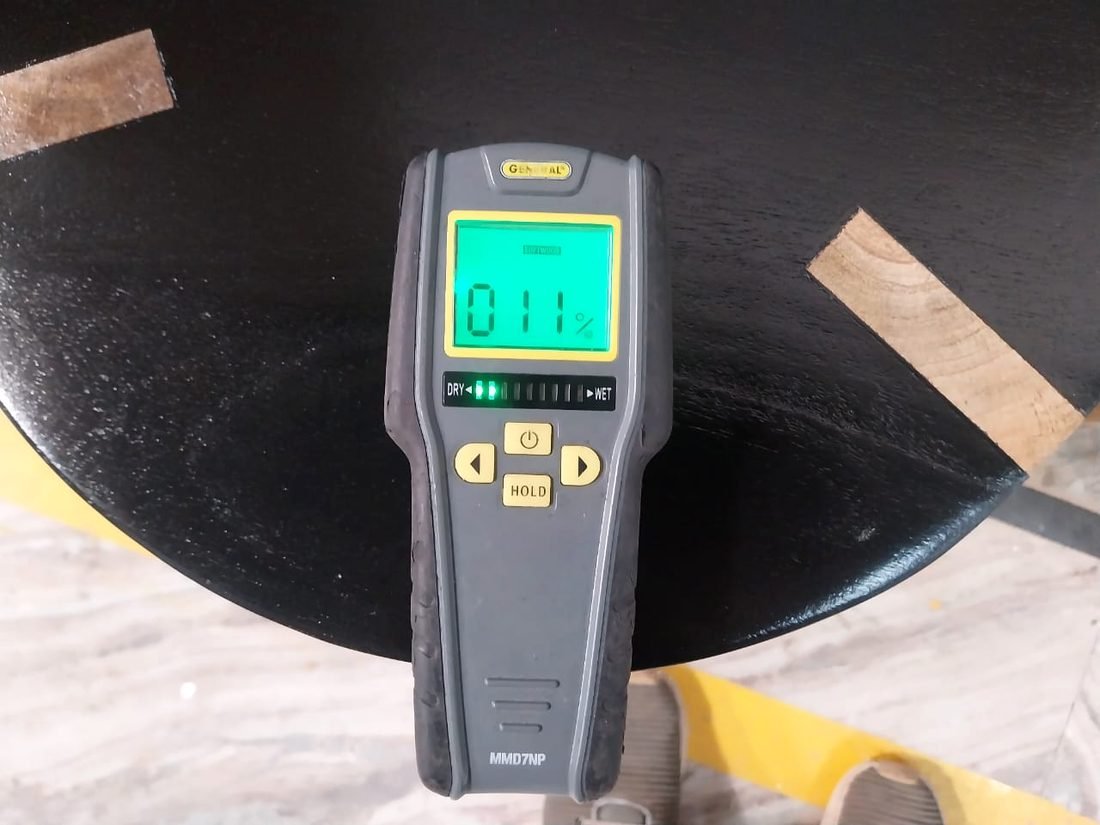
Put two coffee tables side by side in a supplier's photos and they can look identical: same walnut tone, same tapered legs, same rounded corners. Yet one can cost almost double the other. Very often the difference is that one is solid wood and the other is a thin veneer over particle board, and you only find out when the edge banding starts to lift.
You don't need special tools to tell the difference. You need to know where to look.
1. Look at the edges
On a solid wood top, the grain on the surface carries over the edge and down the side. You can follow a single line of grain around the corner. On veneer, the edge usually gives it away: a thin strip glued on with a slightly different grain, or a hairline where the face veneer meets the board underneath. Run a fingernail along the edge. If you feel a seam, it's almost certainly veneer or laminate.
2. Match the grain top and bottom
Pull out a drawer, tip a chair over, or look under a table top. Solid wood shows the same type of grain on both faces, with knots and colour variations that make sense from one side to the other. Engineered board underneath looks like compressed chips (particle board), very even fine fibres (MDF), or neat alternating layers (plywood). Some makers paint or stain the underside to hide this, so check the inside of a drawer front or the back of a cabinet too.
3. Feel the weight
Solid hardwoods such as sheesham and acacia are heavy for their size. If you pick up a chair and it feels lighter than you expected, it may be hollow, made of a lighter wood, or built from board. Weight alone doesn't prove anything, because MDF is also heavy, but combined with the edge and grain checks it tells you a lot.
4. Look for movement and repeat patterns
Real wood has small irregularities: a knot here, a colour shift there, grain that changes direction on a wide board. A top where the same knot pattern repeats every 30 cm is likely a printed laminate. On solid wood tables you'll also often see the joints between boards, because wide tops are made by joining several planks side by side. That's normal and a good sign.
Is veneer bad?
Not at all, when it's used for the right reasons and sold honestly. Veneer lets you use beautiful figured wood across a large panel, and a good veneered board stays flatter than a wide solid panel in some climates. Plenty of high-end furniture uses veneer for large cabinet sides and backs. In our own catalogue many storage pieces combine solid mango wood frames with MDF panels, and we say so on every item.
What matters is that you know what you're paying for. A veneered table priced like solid wood is the problem, not veneer itself.
Questions to ask your supplier
- Which parts are solid wood and which are board or veneer?
- What wood species is used, and is it the same throughout?
- Can you send a photo of the underside and an inside joint?
- Is the material list written on the specification sheet?
A supplier who answers these clearly, in writing, is usually one you can work with.
At Sunwoodd Expo we build our range around solid wood, combined with iron, brass, marble, cane and upholstery, and every item in our catalogue lists its materials next to the size. If you'd like to compare for yourself, ask for a sample. Samples are free (one per buyer, with freight at actual cost). See more on solid wood furniture.